This guide is for adults in the UK who have been prescribed iron tablets for iron deficiency anaemia. It explains how and when to take them, what to keep away from them, how to cope with side effects, and what to expect from follow-up. Always follow the instructions from your own doctor or pharmacist, as they know your situation.
Key points
- Iron tablets are absorbed best on an empty stomach, but taking them with food is fine if they upset your stomach.
- Leave a 2-hour gap between your tablet and tea, coffee, milk and dairy, and eggs.
- Side effects such as constipation, feeling sick and dark poo are common. If they are a problem, talk to your doctor: a lower dose or one tablet every other day may help.
- Most people feel better within 3 to 4 weeks, but you usually keep taking iron for around 3 months after your blood count is back to normal.
- Tablets fix low iron, but finding out why it was low matters just as much.
Why you have been given iron tablets
Iron deficiency anaemia means your body does not have enough iron to make healthy red blood cells. If a blood test shows your red blood cell count is low, iron tablets are usually the first treatment.[5] For more on what it is and why it happens, see our iron deficiency anaemia guide.
The iron medicines you are most likely to be prescribed
The British Society of Gastroenterology (BSG) recommends starting with one tablet a day of a standard iron salt: ferrous sulfate, ferrous fumarate or ferrous gluconate.[6] They all do the same job. They contain different amounts of iron per tablet, so the tablet sizes are not directly comparable, and your prescriber will choose the medicine and dose for you.
| Medicine | Who usually starts it | How it is usually taken |
|---|---|---|
| Ferrous sulfate | GP or hospital team | The NHS says the usual adult dose for anaemia is one 200mg tablet, usually once a day, though some people are prescribed it 2 or 3 times a day.[1] |
| Ferrous fumarate | GP or hospital team | Comes in different strengths as tablets, capsules or liquid. The NHS says it is usually taken once a day.[7] |
| Ferrous gluconate | GP or hospital team | Another standard iron salt the BSG lists as a first choice, usually one tablet a day.[6] |
| Ferric maltol | Usually a hospital team | One 30mg capsule twice a day, morning and evening, on an empty stomach, for at least 12 weeks.[8] See the section on ferric maltol below. |
Always take the dose on your label. Do not change it, or swap one iron medicine for another, without speaking to your doctor or pharmacist.
When to take your iron tablets
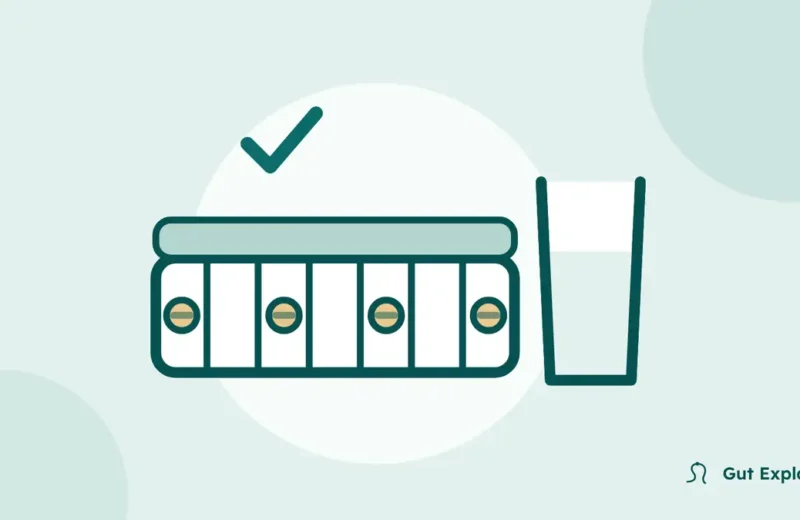
Iron is absorbed best on an empty stomach. If you can, take your tablet 30 minutes before eating, or 2 hours after eating.[1] The BSG notes that taking iron with food significantly reduces how much is absorbed.[6]
But the best routine is one you can stick to. If taking iron on an empty stomach makes you feel sick or gives you tummy pain, it is fine to take it with or just after a meal or snack.[1][2] A little less iron absorbed is better than stopping the tablets altogether.
- Swallow the tablet whole with a drink of water. Do not suck or chew it, as this can cause mouth ulcers or stain your teeth.[1]
- Pick a time you will remember every day, such as when you get up.
- If you forget a dose, take it as soon as you remember, unless it is nearly time for your next one. Never take 2 doses to make up for a missed one.[1]
Food, drink and medicines to keep apart
Some foods and drinks reduce how much iron gets into your body. Leave a 2-hour gap between your iron tablet and:[1][3]
- tea and coffee
- milk and dairy products, such as yoghurt and cheese
- eggs
Wholegrain cereals can also reduce iron absorption.[5] If your morning routine is tea and cereal, it may be easier to take your tablet mid-morning or mid-afternoon instead.
What about orange juice? The NHS says drinking orange juice with or after your tablet may help your body absorb the iron.[1][5] The BSG guideline, however, does not recommend adding vitamin C, as a large trial found no clear benefit.[6] In practice, a glass of orange juice is fine if you like it, but you do not need to buy vitamin C supplements.
Other medicines. Iron can affect, or be affected by, a number of medicines. These include antacids and other indigestion remedies, calcium, magnesium and zinc supplements, some antibiotics (such as doxycycline and ciprofloxacin), levothyroxine for thyroid problems, and bisphosphonates for bone health.[4] It is usually a good idea to leave a gap between iron and other medicines. Ask your pharmacist how long the gap should be for your medicines.[4]
Side effects and how to cope with them
Side effects are common and are the main reason people stop taking iron. Most can be managed. Common ones include:[2][5]
- Feeling sick, tummy discomfort or heartburn. Try taking your tablet with, or just after, a meal or snack.
- Constipation. Eat more fibre, drink plenty of water and try to be more active.
- Diarrhoea. Drink plenty of fluids, such as water or squash. Do not take medicines for diarrhoea without checking with a pharmacist or doctor first.
- Darker poo. This is common with iron and is usually nothing to worry about.
If side effects are still bothering you after trying these tips, speak to your doctor or pharmacist rather than quietly stopping.[2] The NHS advises keeping going with your tablets even if you get side effects, and there are options that can help.[5] You can use our free symptom diary to note when you take your tablet and any side effects, which makes that conversation easier.
Every-other-day dosing
You may have read that taking iron every other day can work as well as, or better than, taking it daily. Here is what UK guidance says.
The BSG recommends starting with one tablet a day. If you cannot tolerate that, your doctor should consider a reduced dose of one tablet every other day, a different iron preparation, or iron given through a drip.[6] The NHS also says that if you get side effects, your doctor may advise taking your tablets on alternate days.[1]
So every-other-day dosing is a recognised option, especially if daily tablets disagree with you. It is a change to discuss with your doctor or pharmacist, not one to make on your own, because the right plan depends on how low your iron is and how quickly it needs to come up. Many people find it far easier to keep going with fewer tablets and fewer side effects.
The BSG does not recommend slow-release (modified-release) iron tablets, as they do not improve absorption or reduce side effects.[6]
If standard iron tablets don’t suit you: ferric maltol
Some people cannot keep taking ferrous tablets because of side effects, even after changing the timing or dose. If that happens, your doctor has several options: a different preparation, every-other-day dosing, or iron given through a drip (an iron infusion).[6] One of the other preparations a hospital team may consider is ferric maltol.
What it is and how it is taken
Ferric maltol is an oral iron capsule licensed in the UK to treat iron deficiency in adults and young people aged 12 and over. The usual dose is one capsule twice a day, morning and evening, swallowed whole with half a glass of water on an empty stomach, because food reduces how much iron is absorbed. Treatment usually lasts at least 12 weeks, and blood tests guide how long you need it.[8]
It is not recommended during a flare of inflammatory bowel disease (IBD), or for people with IBD whose haemoglobin is below 95g/L, and it should not be taken at the same time as an iron infusion.[8] It is usually started by a hospital team, and whether it is offered depends on local NHS prescribing policy. In Scotland, the Scottish Medicines Consortium has not recommended it for routine NHS use.[11]
What the research shows
Most of the research is in adults with IBD, a group in whom iron deficiency is common and standard tablets often disagree.
- Compared with a dummy capsule. Two identical trials included 128 adults with IBD who had already had problems with standard iron tablets. Over 12 weeks, haemoglobin rose much more with ferric maltol than with a dummy capsule (placebo), and about two in three people taking it reached a normal level. Tummy side effects were reported about as often with ferric maltol as with the dummy capsule (38 in 100 people compared with 40 in 100).[9]
- Compared with an iron infusion. A larger trial of 250 adults with IBD compared ferric maltol with an infusion of ferric carboxymaltose. At 12 weeks, more people had responded to the infusion (84 in 100) than to the capsules (67 in 100), so the capsules worked more slowly. By one year, the rise in haemoglobin was similar with both.[10]
- Side effects compared with an infusion. In the same trial, side effects, mainly tummy pain, nausea, diarrhoea and constipation, were more common with the capsules than with the infusion. About 10 in 100 people stopped the capsules because of side effects, compared with about 3 in 100 having the infusion.[10] Infusions have their own risks, including rare allergic reactions and, with ferric carboxymaltose, low blood phosphate in some people who need repeated doses.[12]
In short, ferric maltol can be a useful tablet option for people who could not manage standard iron, and it means some people avoid a hospital visit for an infusion. It works more slowly than an infusion, so if your iron needs to come up quickly, an infusion may still be the better choice. Your specialist team will talk through which option suits you.
How long you take iron for, and follow-up
Most people begin to feel better after 3 to 4 weeks, but it can take 2 to 4 months for the tablets to work fully.[3]
- Checking it is working. The BSG advises checking your blood count within the first 4 weeks to make sure your haemoglobin is rising.[6] Your GP may do repeat blood tests over the following months.[5]
- Carrying on after your blood count is normal. Once your haemoglobin is back to normal, you usually keep taking iron for around 3 more months to refill your body’s iron stores.[6] Overall, many people take iron for about 6 months.[5]
- If tablets do not work or you cannot take them. Iron given through a drip (an iron infusion) is considered if tablets are not suitable, are not working, or are not tolerated.[6]
Why finding the cause matters
Iron tablets replace what is missing, but they do not explain why your iron was low. Heavy periods and pregnancy are very common causes. Others include slow bleeding from the gut, for example from stomach ulcers, inflammation, or anti-inflammatory painkillers such as ibuprofen and aspirin. Less often, the cause is a cancer of the bowel or stomach.[5]
If the reason is not clear, your GP may arrange more tests, such as a poo test that looks for hidden blood, or a referral to a specialist.[5] That may mean a camera test of your stomach (gastroscopy) or bowel (colonoscopy). Being referred does not mean something serious has been found. It means your doctors are being thorough. Please keep any appointments you are offered, even once you feel better on iron.
If those tests do not find the cause, or your iron keeps dropping despite treatment, you may be offered a test of the small bowel, which sits between the stomach and the large bowel and cannot be fully seen with either camera test.[6] This is usually a capsule endoscopy: you swallow a camera the size of a large pill, which takes thousands of pictures as it passes through. Our guide explains how to prepare and what the day is like.
When to get help
Call 999 if you have signs of a serious allergic reaction after taking iron: swollen lips, mouth, throat or tongue, difficulty breathing, or you become confused or very drowsy. Do not drive yourself to A&E.[2]
Talk to a doctor or call NHS 111 straight away if your poo is black and tar-like, or red, or has blood in or on it, or you feel unwell in any other way.[2] Darker poo is normal on iron. Tar-like or bloody poo is not.
If a child swallows iron tablets, or anyone takes more than the prescribed dose, contact NHS 111 for advice now.[1] Call 999 if they are very unwell, for example fitting or unconscious. Keep iron tablets out of sight and reach of children, as an overdose can be fatal.[1]
Ben’s view: the tablets only work if you keep taking them
I run an iron deficiency anaemia clinic, and one of the things I talk about most is not the diagnosis but the tablets themselves. Iron does its job slowly, and the side effects often arrive before you feel any better. That is exactly when people are tempted to give up. If the tablets are disagreeing with you, please tell someone. There is almost always a way round it, whether that is taking them with food, changing the timing, trying every other day or, if needed, an infusion.
The other thing I always explain is that the tablets are only half the story. I help vet urgent referrals for iron deficiency anaemia, and the question we are always asking is why the iron was low in the first place. Feeling better on iron is good news, but it does not answer that question. So if you are offered a test such as a gastroscopy, please go, even if you feel well by then.
When standard tablets really haven’t worked out, ferric maltol is one of the options we consider in clinic, and I have prescribed it. For some people it means they can stay on tablets and avoid coming in for an infusion. I’m always honest that it works more slowly than an infusion, so it isn’t the right choice for everyone, and it’s a decision we make together.
 Ben Johnson
Lead Author & Advanced Clinical Practitioner, Gastroenterology
Frequently asked questions
What is the best time of day to take iron tablets?
There is no single best time. What matters most is taking them on an empty stomach if you can (30 minutes before food or 2 hours after), keeping them 2 hours apart from tea, coffee, dairy and eggs, and choosing a time you will remember.[1] If they upset your stomach, take them with food instead.
Can I take iron tablets every other day?
Sometimes, yes. UK guidance starts with one tablet a day, but if that causes side effects, your doctor may suggest one every other day.[1][6] Check with your doctor or pharmacist before changing how you take them.
Why is my poo dark on iron tablets?
Darker poo is a common side effect of iron and is usually nothing to worry about. But if your poo is black and tar-like, red, or has blood in it, or you feel unwell, talk to a doctor or call NHS 111 straight away.[2]
How long does it take for iron tablets to work?
Most people start to feel better after 3 to 4 weeks, but it can take 2 to 4 months for the tablets to work fully.[3] You will usually carry on for around 3 months after your blood count returns to normal.[6]
Can I drink alcohol while taking iron tablets?
Yes. The NHS says you can drink alcohol while taking ferrous sulfate.[3]
Is ferric maltol better than ordinary iron tablets?
Not for everyone. Standard iron tablets are the first choice for most people.[6] Ferric maltol is mainly used when those have not worked or could not be tolerated, and it is usually started by a hospital team.[9][11] Ask your doctor whether it is an option for you.
References
- NHS. How and when to take ferrous sulfate. Page last reviewed 9 February 2023. https://www.nhs.uk/medicines/ferrous-sulfate/how-and-when-to-take-ferrous-sulfate/
- NHS. Side effects of ferrous sulfate. Page last reviewed 9 February 2023. https://www.nhs.uk/medicines/ferrous-sulfate/side-effects-of-ferrous-sulfate/
- NHS. Common questions about ferrous sulfate. Page last reviewed 9 February 2023. https://www.nhs.uk/medicines/ferrous-sulfate/common-questions-about-ferrous-sulfate/
- NHS. Taking ferrous sulfate with other medicines and herbal supplements. Page last reviewed 9 February 2023. https://www.nhs.uk/medicines/ferrous-sulfate/taking-ferrous-sulfate-with-other-medicines-and-herbal-supplements/
- NHS. Iron deficiency anaemia. Page last reviewed 26 January 2024. https://www.nhs.uk/conditions/iron-deficiency-anaemia/
- Snook J, Bhala N, Beales ILP, et al. British Society of Gastroenterology guidelines for the management of iron deficiency anaemia in adults. Gut. 2021;70(11):2030. https://gut.bmj.com/content/70/11/2030
- NHS. How and when to take ferrous fumarate. Page last reviewed 13 March 2026. https://www.nhs.uk/medicines/ferrous-fumarate/how-and-when-to-take-ferrous-fumarate/
- Electronic Medicines Compendium. Ferric maltol 30mg hard capsules: Summary of Product Characteristics. Accessed October 2026. https://www.medicines.org.uk/emc/product/2083/smpc
- Gasche C, Ahmad T, Tulassay Z, et al. Ferric maltol is effective in correcting iron deficiency anemia in patients with inflammatory bowel disease: results from a phase-3 clinical trial program. Inflamm Bowel Dis. 2015;21(3):579-588. doi:10.1097/MIB.0000000000000314. https://pmc.ncbi.nlm.nih.gov/articles/PMC4342319/
- Howaldt S, Domènech E, Martinez N, et al. Long-term effectiveness of oral ferric maltol vs intravenous ferric carboxymaltose for the treatment of iron-deficiency anemia in patients with inflammatory bowel disease: a randomized controlled noninferiority trial. Inflamm Bowel Dis. 2022;28(3):373-384. doi:10.1093/ibd/izab073. https://pmc.ncbi.nlm.nih.gov/articles/PMC8889281/
- Scottish Medicines Consortium. Ferric maltol 30mg hard capsules (SMC2500), resubmission advice. 2023. https://scottishmedicines.org.uk/media/7361/ferric-maltol-feraccru-resub-final-dec-2022-updated-12123-for-website.pdf
- Medicines and Healthcare products Regulatory Agency. Ferric carboxymaltose: risk of symptomatic hypophosphataemia leading to osteomalacia and fractures. Drug Safety Update, November 2020. https://www.gov.uk/drug-safety-update/ferric-carboxymaltose-ferinject-risk-of-symptomatic-hypophosphataemia-leading-to-osteomalacia-and-fractures